
Why I built FolioXR: the work deserves better than the way we show it
By Jordan Ford, Founder & Creative Director of FolioXR
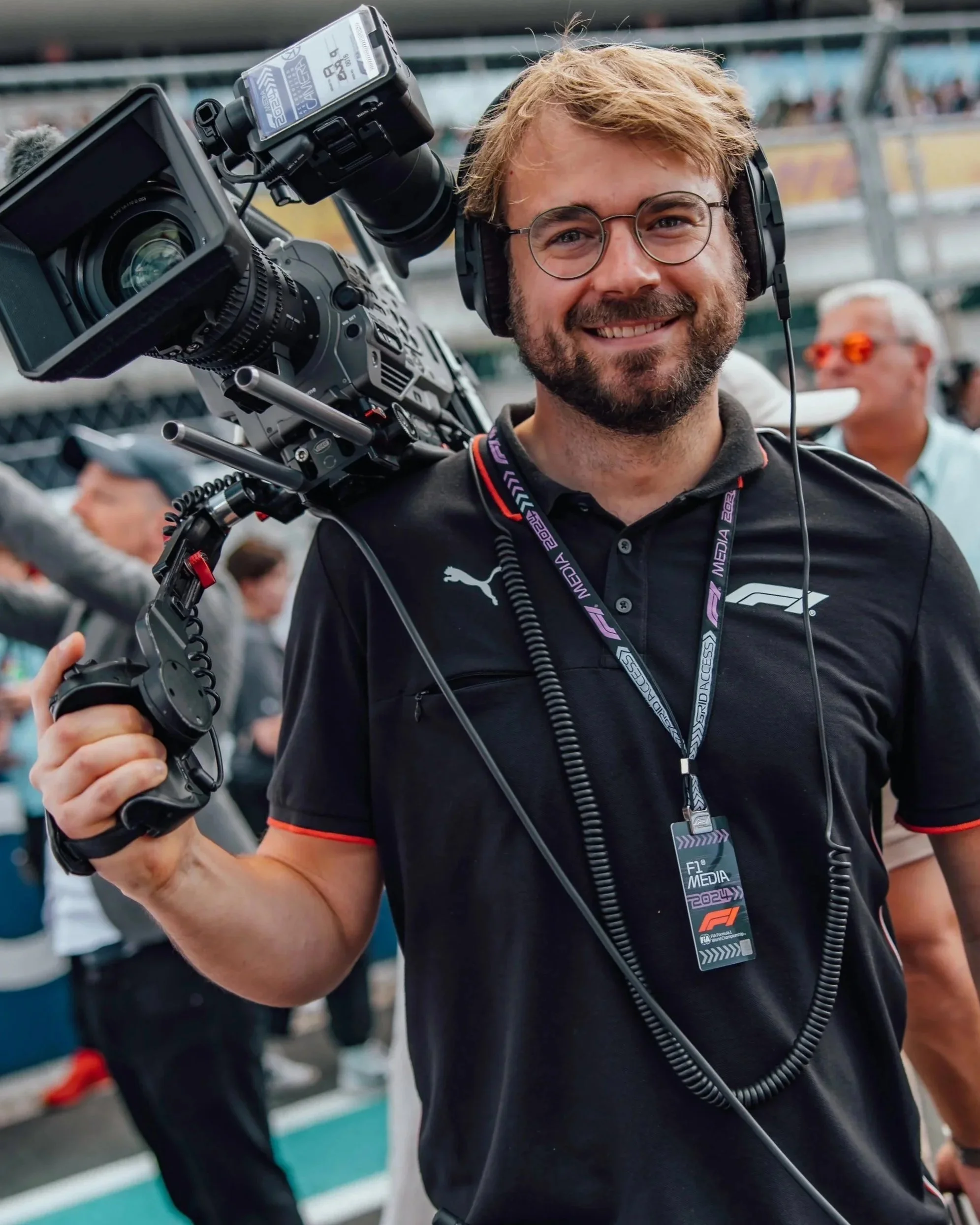
I've spent the last thirteen years behind a camera. Formula 1 pit lanes, global campaigns, pitch-side at cup finals, all across nearly forty countries. Always telling myself “Think Epic.” I always tried to capture imagery and stories that inspire and entertain. Always chasing that goosebumps moment.
It fueled my obsession with technology. Cameras, lenses, and camera movement systems have all moved forward so much in 13 years. Year-on-year iteration cycles born from a compelling tech-race from competitor manufacturers to push the boundaries of filmmaking. Quality, frame rates, low-light sensors. My god, I love it. It all facilitated one thing, how we can capture and tell a story.
All the while, I have grown up around construction and design my whole life. It’s in the family. And in 20 years of being around that world… nothing has changed.
The most visual industry presents itself in the least visual way.
Architecture and design might be the most inherently spatial, visual, emotional work human beings do. We shape the places people will live, work, and learn in for generations.
And yet, when the moment comes to win the work, to convince an investor, a planning committee, a board, a community, we reach for flat drawings and slide decks. In 2026? Really?
Architectural drawings date back to 2200 BC. PowerPoint turns forty next year. The tools we design with have been utterly transformed in the last two decades. The hardware world has exploded. However, the tools we present with have barely moved.
Here's the cost of that gap: the people making the decisions are rarely the people trained to read the drawings. An investor, client, or anything other stakeholder squinting at a general arrangement plan is not experiencing your scheme or why those decisions are the right ones. They're decoding it. Every minute spent trying to understand something can be a minute gained feeling unsure or emotionally checking out.
Seeing is understanding.
FolioXR exists to close that gap.
Our mission is simple to say and complex to deliver: help designers, architects, and developers showcase their work in a way that is as creative, immersive, and as impactful as the work itself, so they can educate their stakeholders and win more of the projects they deserve.
In practice, that means taking the assets you have, the Revit models, the CAD, the drawings, original media, and crafting them into an experience someone can step inside. Pick up the massing model and turn it in your hands. Walk the finished building at full scale before the ground is broken. Stand on site at key moments through immersive film, with the designers themselves explaining each decision.
When someone experiences a scheme this way, nothing needs translating. Nobody asks them to imagine. The architect Juhani Pallasmaa wrote about how we understand buildings through the body, not just the eye. That's precisely the register we work in. Not a diagram of the idea, but the feeling of the place.
Seeing is believing. Seeing is understanding. And understanding is what wins work.
Participants, not spectators.
Digital media is at a defining moment. The real and virtual worlds converge, changing our relationship with ideas. We become participants, not spectators.
Within a decade, presenting a major scheme without an immersive model will feel like presenting one without drawings. Planning committees and procurement panels will expect to stand inside the scheme they’re approving. They should. We ask communities to trust artists’ impressions with their neighborhoods and boards to trust cross-sections with nine-figure investments. That’s normal, but strange.
The hardware excuse is expiring. The headset era is giving way to lightweight headsets and glasses for client meetings. When immersive presentation no longer requires devices, the last practical objection goes away. The practices building spatial content, workflows, and confidence will be fluent when that moment arrives. The ones waiting for the technology to be “ready” will discover it got ready without them.
The deepest shift is social. The presentation as we know it, one person transmitting at a room, is a relic of the tools we had. What replaces it is shared presence: architects, developers, investors, and communities standing inside the same scheme at the same time, pointing at the same doorway, disagreeing about the same sightline, resolving it there and then. It’s a conversation held inside the idea itself.
It means a community group can feel ownership of a designed public square before it exists. It means a board can walk the asset they’re asked to fund. It means the intent behind every design decision survives the journey from studio to boardroom.
That’s the future of showcasing, educating, communicating, inspiring, and doing business. The only real question is whether your practice helps define it or catches up to it.
The work deserves it.
Every practice we work with has a portfolio full of projects that took years of craft, argument, revision, and care. My job, and the job of everyone at FolioXR, is to make sure that when those projects step out into the world to be judged, they arrive carrying all of that meaning with them.
How we showcase our work should carry as much intent and impact as the work itself. That's the belief this company is built on.
If you've ever walked out of a pitch knowing the room never truly saw what you'd made, that's the problem we exist to solve. And if you've ever wondered what it would feel like to hand someone your vision rather than describe it to them, I'd love to show you.
See design differently.
Request a Strategic Consultation
Submit the form below to initiate a discovery dialogue and explore how our specialists can implement tailored solutions that accelerate your objectives.